Simple, practical ways to help your child feel safe, confident, and prepared before the first day of school.
Estimated Reading Time: 8–10 minutes
In This Guide
- Why preparing for school looks different for children with RAD
- How to make school feel familiar before the first day
- Simple routines that build confidence
- Practical steps you can start this week
Preparing for School Looks Different
The back-to-school season is exciting for many families.
New backpacks.
Fresh school supplies.
Meeting the teacher.
Picking out the first-day outfit.
For children with Reactive Attachment Disorder (RAD), however, a new school year can also bring uncertainty. New teachers, new classmates, new routines, and new expectations can feel overwhelming.
As parents, we know our children don’t just need school supplies.
They need preparation.
The good news is that preparing your child doesn’t have to be complicated. Small, intentional steps before school starts can help reduce anxiety and make the transition much smoother.
You are the expert on your child.
No teacher, counselor, or principal knows your child the way you do. You have seen the victories, the struggles, the triggers, and the incredible growth that no one else gets to witness.
That perspective matters.
Let’s begin by making school feel familiar before the first bell ever rings.
Talk About School Before It Starts
Don’t wait until the night before school starts to begin talking about it.
Instead, start a few weeks early by weaving school into everyday conversations.
Mention the teacher’s name.
Talk about friends they might see.
Drive by the school if it’s nearby.
Read books about the first day of school.
The goal isn’t to talk at your child.
It’s to make school feel familiar.
Children with RAD often struggle with uncertainty. The more predictable something feels, the less emotional energy they have to spend worrying about what’s coming next.
Simple conversations can make a big difference.
You might say:
- “I wonder what your classroom will look like.”
- “I’m excited to meet your teacher.”
- “I bet your library has some fun new books this year.”
- “What are you most excited about?”
Keep the conversations light and positive.
You’re planting seeds of familiarity.
From Our Home to Yours
A couple of weeks before school starts, we begin talking about school naturally throughout the day.
We might mention a teacher’s name, wonder who will be in Bella’s class, or stop by the school if we’re already driving nearby.
Nothing forced.
Just little conversations that help school become part of everyday life instead of one big unknown.
We’ve learned that those small moments matter.
When the first day arrives, school isn’t something completely new.
It’s already become familiar.
Try This:
Choose one way to make school feel familiar:
- Read a back-to-school book together.
- Drive by the school.
- Talk about the teacher during dinner.
- Let your child help pick out school supplies.
- Practice walking into the school if it’s allowed.
Small conversations today can create confidence tomorrow.
Remember…
The goal isn’t to make school feel perfect.
The goal is to make it feel familiar.
Re-establish Your School Routine
One of the best gifts you can give your child before the first day of school is predictability.
Don’t wait until the night before school starts to switch back into school mode.
Instead, begin making small changes about two weeks before school begins.
Move bedtime back a little earlier every few nights.
Wake your child a little earlier each morning.
Start eating breakfast around the same time you’ll need to during the school year.
Small changes feel much less overwhelming than one big change all at once.
Children with RAD often struggle when life suddenly becomes unpredictable. Re-establishing routines before school starts helps your child know what to expect before they ever walk through the classroom door.
These routines don’t have to be perfect.
They just need to become familiar.
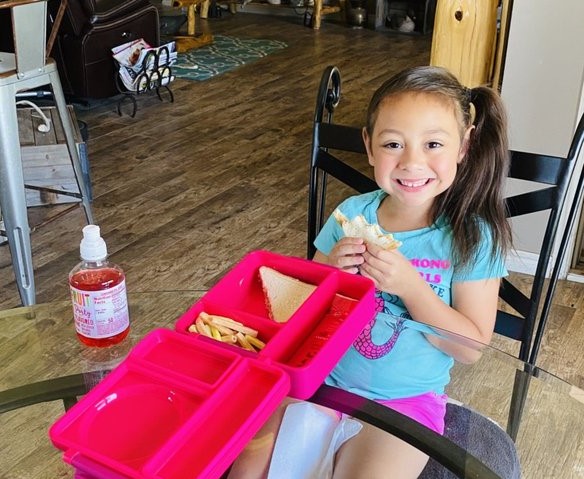
If your child is starting kindergarten, don’t forget to practice lunchtime.
Most school lunches last only 20–25 minutes.
That isn’t much time to open containers, unwrap food, eat, and socialize.
Practice at home by packing a lunch and letting your child do as much as they can independently.
- Open every container.
- Unwrap snacks.
- Open juice boxes or water bottles.
- Throw trash away.
- Finish eating within about 20 minutes.
As a teacher, I can tell you this simple practice builds confidence before your child ever walks into a busy cafeteria.
School mornings become easier when everything has a place.
Choose where backpacks go.
Choose where shoes belong.
Pack lunches the night before.
Lay out clothes before bedtime.
These routines may seem small.
But small routines create calmer mornings.
From Our Home to Yours
Routine is one of the biggest priorities in our home.
Over the years, we’ve learned that when Bella knows what to expect, everyone has a better day.
Not because every day is easy.
Because it’s predictable.
About two weeks before school starts, we slowly transition back into our school routine. Bedtime gets a little earlier. Mornings begin a little sooner. We start eating meals closer to our school schedule, and Bella begins putting her backpack back in its designated spot each evening.
One thing I’m especially glad we practiced was lunch before kindergarten.
Bella had never carried a lunch tray, opened containers in a noisy cafeteria, or eaten with dozens of children around her.
So we practiced.
We packed lunches together, sat at the kitchen table, and pretended we were at school. She practiced opening every container by herself and eating within the amount of time she’d have at school.
Looking back, that simple practice gave her one less thing to worry about on her first day.
Sometimes it’s the little things that make the biggest difference.
Try This:
Choose one routine to practice this week.
- Move bedtime back 15 minutes.
- Wake up a little earlier each day.
- Eat breakfast at your school-day time.
- Lay out clothes the night before.
- Pack backpacks before bedtime.
- Practice opening lunch containers independently.
Remember:
The goal isn’t a perfect morning.
The goal is a predictable one.
Before You Go
Preparing your child for a new school year isn’t about doing everything perfectly.
It’s about taking small, intentional steps that help school feel a little less overwhelming and a little more familiar.
Some years will go smoothly.
Others may be harder.
That’s okay.
Remember, you know your child better than anyone else.
Your preparation, your advocacy, and your consistency matter more than you probably realize.
Every conversation…
Every practiced routine…
Every trip to the school…
Every moment you spend helping your child feel safe is an investment in their success.
You don’t have to prepare perfectly.
You simply have to prepare with love.
Remember…
Children with RAD don’t need perfect parents.
They need parents who help them feel safe, seen, and supported.
From Our Home to Yours:
If no one has told you lately…you’re doing better than you think.
Parenting a child with RAD is one of the hardest journeys a family can walk, but you don’t have to walk it alone.
Thank you for letting me be part of your story.
– Carissa
 Loving Bella
Leave a comment